Empires & Puzzles: Match-3 RPG
- 4.5
- Rating
- 50.00M
- Installs
- Free
- Price
 Analysis by App-foxy
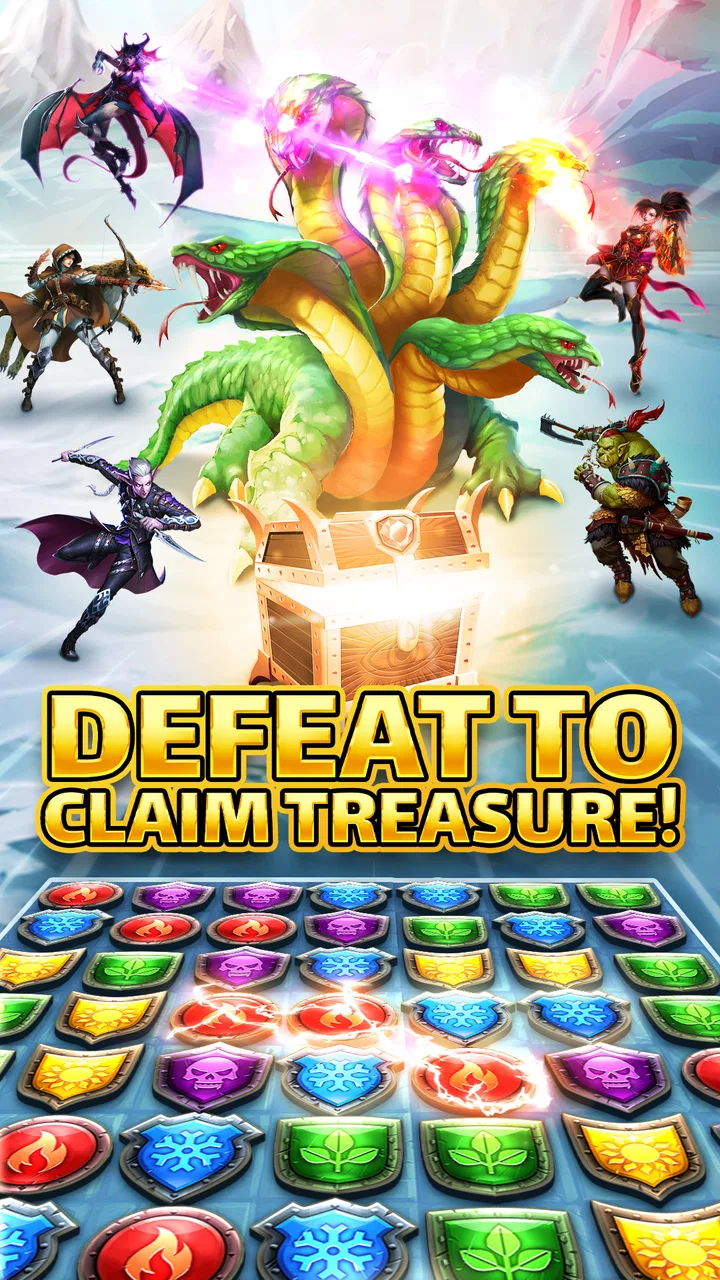
I spent time with Empires & Puzzles: Match-3 RPG as a puzzle game that tries to make every short board feel connected to a larger adventure. You match colored pieces, build a team of heroes, improve a personal base, and take on monsters. That combination gives it a different rhythm from a traditional match-three game: a good move is not only about clearing tiles, but also about preparing attacks, protecting a fragile team, and deciding where limited progress should go next.
My first impression was that it is easiest to enjoy in small sessions. A quick battle can fit into a spare moment, while collecting heroes and developing the base gives longer-term goals when I want something more involved. The game is free to start, and its Everyone 10+ rating makes it broadly approachable, although the in-app purchase range—from $0.99 to $199.99 per item—means I would pay attention to spending if children use the device.
How the puzzle battles feel in everyday play
The core appeal comes from the way the board and the hero team depend on each other. Matching tiles is familiar, but the result feels more deliberate because the colors connect to the heroes available for a fight. I found myself looking beyond the most obvious match. A small clear can be useful if it lines up an attack, opens space for another move, or helps me avoid leaving the board in an awkward shape.
You May Also Like

 Blood Strike: 2.5 Anniversary
Blood Strike’s Loadouts Turn Every Drop Into a Tactical Gamble
A close look at Blood Strike’s custom loadouts: how fast access to signature weapons reshapes its battle royale rhythm, rewards preparation, and narrows the gap between fights.

 Pandora - Music & Podcasts
Pandora’s Music Is Easy to Start, but Harder to Recover
Pandora’s strength is its low-effort path from a seed to a station. Its weak spot is how much confidence it asks you to place in connection, setup, and quiet recovery.

 8 Ball Pool
 Is Built on Rivalries, Rematches, and Routine
A close look at the rivalries, rematches, shared routines, and unanswered safety questions that turn a quick pool match into a persistent mobile community.

 Samsung Music
’s Quiet Strength Is Playing What You Already Own
Its reach comes less from spectacle than from dependable access to a personal library. That simplicity is both the app’s strongest retention engine and its ceiling.

 AccuWeather: Weather Radar
AccuWeather Review: A Quick, Clear Forecast for Everyday Decisions
For everyday plans, the best forecast is the one you can understand quickly. AccuWeather makes rain timing, radar, and local conditions easy to act on, with a few trade-offs.

 Hill Climb Racing
Why Hill Climb Racing Still Turns Crashes Into One More Run
A tiny car, a bumpy hill and one more upgrade: Hill Climb Racing keeps resurfacing because its simple chaos makes every near-miss feel personal.
More From Our News Desk
View All News


That extra layer is what separates this from a simple time-killer. In an ordinary match-three game, I can often make a few casual moves and still feel successful. Here, careless choices can make a battle less comfortable, especially when the opposing monsters begin to pressure the team. I enjoyed that tension, but it also means the game asks for more attention than a purely relaxing puzzle.
The hero-collection side gives the matches a reason to matter after the board disappears. Building a roster encourages experimentation, while the base creates a place for longer-term improvement. I like this structure because it gives me several ways to make progress: I can focus on a battle, work on my heroes, or spend time improving the broader setup around them.
One useful habit is to avoid treating every new hero as an automatic upgrade. A larger collection can become difficult to manage if I spread resources across everyone. I get better results by deciding which group I actually use, then improving that group consistently. This is one of the less obvious lessons of the game: collecting is exciting, but focused development is usually more satisfying than constantly resetting my priorities.
Why the pace can feel quick at first
The opening experience is easy to understand because matching tiles requires no complicated control scheme. I can begin a battle quickly, make a move with a tap or swipe, and see the result immediately. That gives the game a brisk surface feel, particularly when I am playing one encounter rather than trying to manage the entire collection.
The pace changes once I start thinking about progression. Choosing heroes, deciding what deserves improvement, and checking the base can take longer than the individual puzzle turns. This is not a performance problem; it is the design asking me to alternate between quick actions and slower planning. Players who want a pure arcade puzzle may find the extra menus and decisions interrupt the flow, while RPG fans will probably see them as the reason to return.
For a normal everyday scenario, I can imagine opening it while waiting for an appointment, completing a short activity, and closing it without needing a long uninterrupted session. If I have more time at home, I can continue by reviewing my roster and making progress on the base. That flexibility is one of its strongest practical qualities, although the temptation to keep checking for another improvement can make a short session stretch longer than planned.
Where heavier use puts more pressure on the experience
The most demanding moments are not necessarily the first puzzle boards. They arrive when several systems compete for attention: a difficult fight, an underdeveloped team, and a base that still needs work. At that point, the game feels less like a sequence of isolated puzzles and more like a management routine. I need to think about whether a setback comes from poor matching, weak preparation, or an unbalanced roster.
That is also where the game can feel resource-conscious in a broader sense. I have to be selective about upgrades rather than assuming every reward should be spent immediately. A practical approach is to pause before improving a hero and ask whether that character fits the team I actually enjoy using. This reduces wasted effort and makes later battles feel more coherent.
Longer play sessions can also expose a different kind of friction: repetition. The basic matching language remains approachable, but the surrounding progression can make similar battles feel familiar after a while. I think the game works best when I alternate between puzzle play and roster planning instead of grinding the same activity continuously. If I force myself to play for hours, the strategic layer begins to feel like a checklist rather than a discovery.
Another trade-off is the presence of purchases. The free entry point is useful, but the broad price range for individual items can change how comfortable the progression feels for different players. I would recommend setting a personal spending limit before starting, especially for anyone who enjoys collection systems and finds it difficult to ignore optional improvements. The game is more enjoyable for me when purchases are treated as a choice rather than as part of the normal definition of success.
Stability and what I would expect from different devices
Empires & Puzzles was released on March 1, 2017, and the current version is 83.0.0. That long-running history and continued versioning suggest a game that has had time to evolve, but I would still separate maturity from a guarantee that every device will feel identical. Performance depends on the phone or tablet, the operating system, available storage, and what else is running in the background.
The minimum operating system is Android 7.0, so owners of older Android hardware should check compatibility before planning around it. A device that technically meets the requirement may still offer a less comfortable experience if it has limited memory or little free storage. I would keep the system updated, close demanding apps before a longer session, and leave some room for future game updates rather than filling the device completely.
In normal use, the simple board interaction should not demand the same kind of hardware as a visually intense action game. That makes the title a more reasonable candidate for ordinary phones, but I would not assume that every older device will handle extended play equally well. The practical test is whether menus, transitions, and battles remain comfortable after the game has been open for a while, not merely whether installation succeeds.
Battery expectations also need a little common sense. Short puzzle sessions are easier to fit into a day than prolonged collection management or repeated battles. If I were playing during travel, I would begin with a charged device and avoid treating it as a low-power game by default. The game may be lighter than a high-end 3D title, but any connected, frequently updated game can become more demanding over time than a basic offline puzzle.
How dependable the routine feels
What I value most is the clear separation between immediate play and gradual development. Even when I do not want a long session, I can understand what I am doing: fight, improve, collect, or work on the base. That clarity helps the game feel dependable as a daily habit. I am less likely to open it and wonder what the point of the next few minutes is.
The downside is that the routine can become busy. A player who prefers opening a game, solving puzzles, and leaving without thinking about progression may find the hero and base layers distracting. I would choose a simpler match-three title for that purpose. Here, reliability is partly about personal expectations: it is reliable as a structured progression game, not as a completely frictionless puzzle toy.
I also appreciate that mistakes are informative. If a battle goes badly, I can inspect the team and the board decisions instead of assuming the result was random. The useful recovery strategy is to make one change at a time—adjust the lineup, improve a key hero, or play more carefully—rather than changing everything at once. That makes setbacks easier to understand and prevents the base and roster from turning into an unmanageable experiment.
For someone worried about losing a session, I would keep expectations practical. Any mobile game can be affected by a device restart, an update, or a connection issue, so I would avoid beginning a battle when I need to put the phone away immediately. The game’s short-session design helps, but I still prefer finishing an activity before switching apps or entering a situation where interruption is likely.
Who will enjoy it, and who should choose something else
I would recommend this game to players who like match-three puzzles but want more consequences attached to each move. It suits people who enjoy collecting heroes, comparing team choices, and seeing a base develop over time. It is also a good fit for someone who likes alternating between quick battles and longer planning rather than committing to one continuous campaign session.
I would be more cautious about recommending it to players who dislike progression systems or optional purchases. The collection structure is central, not a small extra placed around the puzzle board. Someone seeking a calm, self-contained game with no roster decisions may be happier with a straightforward match-three alternative. Likewise, a player who wants fast reflex action should look toward an action game, because this experience rewards planning more than speed.
Compared with a standard match-three game, this title offers more reasons to return but also more things to manage. Compared with a conventional role-playing game, its battles are easier to pick up because the main interaction is tile matching rather than complex controls. That middle ground is its identity: it is less pure than a puzzle game and less demanding to operate than a traditional RPG.
The developer, Small Giant Games, has built the experience around that blend rather than treating the puzzle board as a disposable mini-game. In my view, the best players will be those who enjoy making modest decisions repeatedly. The reward is not only clearing a board; it is gradually learning which choices make the next fight smoother.
My practical verdict after using it
Empires & Puzzles has a strong reason to exist because its three parts—matching, heroes, and base development—support one another. The board gives immediate action, the heroes give battles personality, and the base gives progress a longer horizon. I found that combination more engaging than a puzzle game that resets completely after every level.
It is also a game I would approach with boundaries. I would decide in advance how much time and money I want to give it, concentrate improvements on a dependable team, and avoid measuring enjoyment by how quickly I can collect everything. Those habits make the free-to-start structure feel more manageable and reduce the pressure created by optional purchases.
The game has an average rating of 4.5 from around 2.4 million ratings, with more than 50 million installs. Those figures reflect a large audience, but they do not remove the personal trade-offs: the RPG layer may be exactly what one player wants and unnecessary clutter to another. I would judge it by whether I enjoy planning around the board, not simply by its popularity.
Overall, I see it as a solid choice for Android players who want a match-three game with a persistent sense of development. It should work best on a reasonably maintained device running Android 7.0 or later, with enough room and battery for the way you intend to play. My recommendation is positive for patient puzzle fans who enjoy collection and strategy, but not for anyone looking for a completely simple, purchase-free or purely casual alternative.
FAQs for Empires & Puzzles: Match-3 RPG
01What is the main objective of Empires & Puzzles: Match-3 RPG?
The main objective of Empires & Puzzles is to build a strong team of heroes, battle opponents, and progress through levels by matching three or more tiles. These matches trigger attacks against enemies, requiring strategic thinking to maximize your team's abilities and strengths.
02Is Empires & Puzzles free to play?
Yes, Empires & Puzzles is free to download and play. However, it does offer in-app purchases for items like gems, energy refills, and special offers. While these purchases can enhance gameplay, they are not necessary to progress through the game.
03What platforms is Empires & Puzzles available on?
Empires & Puzzles is available on both Android and iOS platforms. You can download it from the Google Play Store for Android devices and the Apple App Store for iOS devices. Ensure your device meets the necessary system requirements for smooth gameplay.
04Does Empires & Puzzles require an internet connection?
Yes, an active internet connection is required to play Empires & Puzzles. This is because the game involves online features such as player-versus-player battles, alliances, and real-time events that require constant connectivity to function properly.
05How does the alliance system work in Empires & Puzzles?
In Empires & Puzzles, players can join alliances to team up with others. Alliances allow members to participate in group activities, such as alliance wars and titans. These cooperative features provide additional rewards and foster a community experience within the game.
Pros
- Engaging match-3 gameplay with RPG elements.
- Stunning graphics and vibrant animations.
- Variety of heroes with unique abilities.
- Regular events keep the gameplay fresh.
- Strong community and alliance features.
Cons
- In-app purchases can be quite costly.
- Energy system limits continuous play.
- Progression can feel slow at times.
- Requires a stable internet connection.
- Some heroes feel unbalanced.

Empires & Puzzles: Match-3 RPG
Gallery